|


ROME: TOTAL WAR
Rome: Total War follows the footsteps of its predecessor, Medieval: Total War, which was touted as one of the best strategy games ever released. Only in this case, naturally, you’re trying to build the Roman Empire through imperialistic ambitions in the ancient Mediterranean. Like
any strategy game, Rome: Total War is a true example of patient
planning and shrewd decision-making, though it’s important
to remember that there are several different ways in which
you can achieve your objectives. For instance, do you conquer
a city and develop it as a commercial centre, or do you allocate
most of the budget to the military and keep the city occupied
with little regard for the population? Do you try to form
an alliance with another city-state that will cost a lot,
or hire cheaper mercenaries to do the dirty work for you?
Do you attack a city when you may have a slight advantage,
or do you wait until after you’ve built up more forces
despite the possibility that the enemy will have stronger
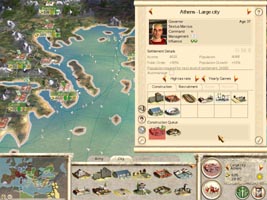
defences by the time you attack? These examples are precisely what Rome: Total War is all about. The structure of the game enables you to command a wide range of tasks, including placing one of your sons as the governor of a captured city and deciding whether to enslave or exterminate the population of that city. But even more than that, your decisions carry an impact a few turns down the line. At the end of each turn, which spans six months, you receive updates as to how much revenue you’ve collected, what’s been built and how the Senate views your actions. You even get updates about prominent Roman weddings, Senate decrees and if a revolt is occurring in any of the Empire’s territories. And
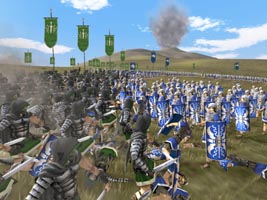
as extensive as the strategic side is, the fighting engine
is a sight worth seeing. Instead of seeing battles fought
on paper, you can play “General” and coordinate
your army of thousands, while watching it all unfold in real-time.
You can even zoom right in and watch the carnage up close.
All the soldiers wear authentic-looking outfits and units
are separated (i.e. spearman, archers, cavalry, light infantry),
while using authentic weapons. The developers even went so
far as to give other cultures different fighting tactics and
preferences. For instance, the Barbarians use human wave tactics
to try to overpower you, while the Greeks prefer to rely on
heavy armor and methodically slow-moving units. I can’t
really say that one works better than the other, since the
developers ensured that every fighting style has strengths
and weaknesses. This part of the game is so good, that you’ll likely be tempted to fight anyone around you, even though it may prove disastrous in the grander scheme of things, which is why equal importance was given to the strategic and fighting parts of Rome: Total War. Of course, we also can’t forget the characters involved in all this because you also have a growing family to worry about. Your family tree is always accessible to you, and will become a crucial tool in policy decisions regarding field and bureaucratic appointments. Character profiles even go as far as to describe the nature of the person, like if they’re heavy drinkers or weak commanders. But it goes even further. You can recruit spies and send them to other cities, both hostile and allied, just to keep tabs on what they’re up to. With their help, you can find out in advance that an attack is coming and gather intelligence on several other aspects of those cities. On top of that, you can build roads and ports to increase trade and merchant traffic between your cities and territories. Armies cost a lot to maintain and the economic side of things is focused on a great deal here. While naval battles aren’t very common, which is a downside, naval blockades are more effective than they should be because the besieged city won’t even try a breakout. It may be an AI glitch or it may have been the developer’s intention, but whatever the case, it’s an unfortunate oversight in the game. Rome: Total War is one of the finest strategy games ever developed, and I’ve already laid out the reasons why. When you factor in the musical score that was used and the excellent cutscenes, not to mention the superb interface, you have a game that is so engaging and historically interesting, it’s hard to stay away. In a sense, that kind of feeling is likely the same type of obsession that Roman Emperors felt when they were watching Rome grow to become the one of the world’s greatest empires. It’s great to see a game that can make you play that role so well. |
Publisher: Rating: 9/10
|

Follow Faze on Twitter @FazeMagazine