|


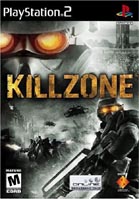
KILLZONE
There were members of the gaming press who dubbed Killzone the “Halo killer,” which is terribly unfair since the developers probably never intended for it to be anything like Halo. Although Killzone is a typical sci-fi shooter, it has an interesting story and elements of its gameplay work well most of the time. The cutscenes are very well done and do a great job of setting the stage for each chapter of the story, and certain influences from past wars, especially World War II, are made fairly obvious. For starters, the opening cutscene showing a mysterious leader addressing thousands of troops neatly lined up in rows is highly reminiscent of the type of spectacles Adolf Hitler and the Nazis put on in the 1930s (the 1934 Nuremberg rally comes to mind). The
basis of the story in Killzone is that humans have colonized
other planets in the Milky Way, but a splinter group called
the Helghast have always been on the sidelines, and moved
from Earth to forge a new society. But after a decade of bulking
up their armed forces and living in squalid conditions, the
Helghast decide to launch a full-out invasion of Earth and
claim it for themselves. As Jan Templar, you’re part
of the ISA (International Strategic Arms), and as I’m
sure you can guess, your job is to help stop the invaders
in their tracks. Your small squad eventually adds a female
sniper and a Helghast deserter, and you have the option of
playing as any of these characters for each mission as the
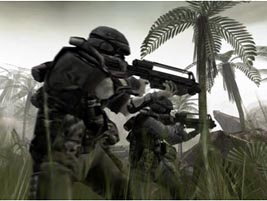
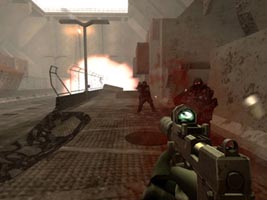
game progresses. The opening levels take you right into the front lines where the Helghast are trying to advance and overrun your position in the trenches. From there, you fight in war-torn cities, the jungle and even snow-capped mountains. While the levels are beautifully designed, they are also incredibly linear, isolating you into a set path of movement. A game like Killzone, which emphasizes that an invasion of epic proportions is going on, would’ve been far better if the levels were much more of an open concept. As is, you’ll probably feel a little constrained as to where you can and can’t go. Another nagging issue throughout the game is the way backgrounds fill in as you move closer to them. I literally walked into a tree once because of this. Since
the massive invasion is the constant backdrop of the story,
seeing some huge battles would’ve been a huge plus for
this game. Instead, we get a situation where you run from
one skirmish to the next, killing small squads of Helghast
before moving on and repeating the same process in the next
mission. Helghast troops sound like a bunch of demonic thugs in this game, and you wouldn’t know they were such a formidable fighting force with how they refuse to fire at you when in their sights. The AI in this game is less than stellar, especially among your allies. The Helghast will at least get tougher as the game goes on, and though your squad can be capable, other allies you come across are not as reliable. It was also very odd to see that ISA troops never wore helmets. All the Helghast would have to do is shoot for the heads of ISA soldiers and it would be over, but then I guess there wouldn’t be a game to play. The single player campaign is a little choppy thanks to AI and design issues, but the online game is much smoother. You’ve got your typical deathmatches and other standard multiplayer games. You won’t get much in terms of stats, but it is a basic online multiplayer shooting game, and that should be enough for the casual gamer. As much as some things could’ve been better, Killzone is still a fun game to play and the premise behind it works as a great story. The visuals are nicely done with excellent cutscenes and cool environments, and the gameplay has a short learning curve. But with all that said, Killzone still lacks the polish that would’ve made it a much bigger hit than it will ever be, which is disappointing because the potential was obviously there for bigger and better things. |
Publisher: Rating: 7/10
|

Follow Faze on Twitter @FazeMagazine